Biosimilars

Post-marketing experience with IBD biosimilars

Biosimilars/Research | Posted 19/05/2017

The introduction of anti-tumour necrosis factor-alpha (TNF-α) monoclonal antibodies (mAbs), about two decades ago, has revolutionized the management of inflammatory bowel disease (IBD). However, they are also expensive and their cost can lead to restricted access for many patients.

Biosimilars applications under review by EMA – April 2017

Biosimilars/General | Posted 19/05/2017

The European Medicines Agency (EMA) is the body responsible for approval of biosimilars within the European Union (EU). A legal framework for approving biosimilars was established in 2003. Approval of biosimilars is based on an abbreviated registration process, which allows biosimilars manufacturers to provide a reduced package of information compared to originator drugs, provided they can prove ‘similarity’ to the originator or reference drug.

Positive phase I results for Cinfa’s pegfilgrastim biosimilar

Biosimilars/News | Posted 19/05/2017

Spanish biosimilars developer Cinfa Biotech (Cinfa) announced on 17 May 2017 that results from the second phase I study of its pegfilgrastim biosimilar (B12019) had met its primary endpoints.

WHO to launch prequalification programme for biosimilars

Biosimilars/General | Posted 12/05/2017

The World Health Organization (WHO) announced on 4 May 2017 that it would launch a pilot project for prequalifying biosimilars. This move says the organization, is a ‘step towards making some of the most expensive treatments for cancer more widely available in low- and middle-income countries’.

Accountability, safety and competition in biologicals markets

Biosimilars/Research | Posted 12/05/2017

Regulatory systems for drug approval aim to reduce the likelihood of drug-related safety problems, but cannot fully eliminate post-marketing safety events. Such safety problems can have substantial consequences for patient’s well-being. For example, the most severe class of recalls issued by the US Food and Drug Administration (FDA) occur about once per month, and have recently been increasing in frequency [1]. Post-marketing surveillance or pharmacovigilance systems enable monitoring of and response to safety problems that may be undetected before drugs reach the general market [2]. When a safety problem occurs, successful identification of the responsible firm, or accountability, depends on the information available to the pharmacovigilance effort [3, 4]. 

Second infliximab biosimilar to be launched in Australia in 2Q 2017

Biosimilars/News | Posted 12/05/2017

Merck Sharp and Dohme (MSD) announced on 1 May 2017 its intention to launch the infliximab biosimilar Renflexis in the second half of 2017.

Computer modelling for glycoengineering of biosimilars

Biosimilars/Research | Posted 04/05/2017

In order to be approved by regulatory agencies, biosimilars are required to match all pharmacological properties of the originator protein drug to guarantee efficacy and alleviate safety concerns.

FDA approves biosimilar infliximab Renflexis

Biosimilars/News | Posted 04/05/2017

Samsung Bioepis announced on 24 April 2017 that the US Food and Drug Administration (FDA) had approved its biosimilar version of Johnson & Johnson and Merck’s Remicade (infliximab).

EMA approval for etanercept and rituximab biosimilars

Biosimilars/News | Posted 28/04/2017

The European Medicines Agency’s (EMA) Committee for Medicinal Products for Human Use (CHMP) announced on 21 April 2017 that it had recommended granting marketing authorization for the etanercept biosimilar Erelzi and for the rituximab biosimilars Rixathon and Riximyo.

Prospective study finds switching to biosimilar infliximab safe

Biosimilars/Research | Posted 28/04/2017

A study of the infliximab biosimilar Remsima has, according to the authors, shown similar ‘safety and survival’ of biosimilar infliximab Remsima compared to the originator biological Remicade [1].

Fujifilm ramps up biosimilars production as UK court allows Humira biosimilar

Biosimilars/General | Posted 28/04/2017

A UK court has ruled in the favour of Japan-based Fujifilm Kyowa Kirin Biologics’ Humira biosimilar. The Fujifilm corporation has also announced a multi-million-dollar investment in its biologicals production facilities in the US.

Rituximab biosimilar safe in advanced follicular lymphoma patients

Biosimilars/Research | Posted 21/04/2017

A study of the rituximab biosimilar CT‑P10 has, according to the authors, ‘demonstrated’ similar pharmacokinetics (PK) and safety when administered in combination with cyclophosphamide, vincristine and prednisone (CVP) in patients with newly diagnosed advanced follicular lymphoma (AFL) [1].

Advances in ranibizumab and teriparatide biosimilars

Biosimilars/News | Posted 21/04/2017

Positive results have been reported from a ranibizumab biosimilar and a teriparatide biosimilar has entered phase III trials.

Biosimilars of certolizumab pegol

Biosimilars/General | Posted 21/04/2017

Certolizumab pegol is a monoclonal antibody directed against tumour necrosis factor-alfa (TNF-α). More precisely, it is a PEGylated Fab’ fragment of a humanized TNF inhibitor monoclonal antibody. It is indicated for the treatment of Crohn’s disease, rheumatoid arthritis, psoriatic arthritis and ankylosing spondylitis.

Harmonization of requirements for NBCDs across regions

Biosimilars/Research | Posted 21/04/2017

Efforts are being undertaken to continuously develop and harmonize the regulatory requirements for complex medicinal products across regions. Taking this into account, authors Ehmann and Pita believe the European Union (EU) network is ready for non-biological complex drugs (NBCDs) [1].

US pharmacists’ views on the naming and labelling of biologicals

Biosimilars/Research | Posted 14/04/2017

The Alliance for Safe Biologic Medicines (ASBM) has published the results of a survey determining the opinions of US pharmacists about the naming and labelling of biosimilars [1].

Trastuzumab biosimilar submitted for approval in Japan

Biosimilars/News | Posted 14/04/2017

Japan-based Nippon Kayaku announced on 11 April 2017 that it had submitted an application for its trastuzumab biosimilar, CT-P6, to the Ministry of Health, Labour and Welfare (MHLW) in Japan.

Italian study compares epoetin biosimilars and originator biologicals

Biosimilars/Research | Posted 14/04/2017

Recently, extensive discussion on the opportunity offered by biosimilars for the sustainability of the National Health Services has taken place in academic and regulatory contexts. The use of biosimilars continues to be limited, and the scepticism of prescribers and patients seem to be linked to the uncertainty of the risk-benefit profile of biosimilars. In the case of epoetins, used in the management of anaemia in the nephrology and oncology settings, the results of a recent study showed no difference between biosimilars and originators on relevant effectiveness and safety outcomes [1].

Increasing access to biosimilars and generics in Europe

Biosimilars/General | Posted 14/04/2017

On 2 March 2017, the European Parliament voted on a resolution to strike a better balance between European Union (EU) countries’ public health interests and those of the pharmaceutical industry.

Basal analogue insulin ‘copy biological’ launched in Indonesia

Biosimilars/News | Posted 07/04/2017

Indonesian generics maker Kalbe Pharma (Kalbe) announced on 25 March 2017 the launch of a basal analogue insulin ‘copy biological’ in Indonesia.

Filgrastim follow-on biological has similar efficacy and safety in breast cancer patients

Biosimilars/Research | Posted 07/04/2017

A study comparing two filgrastim formulations for controlling chemotherapy-induced neutropenia has reported similar efficacy, safety and non-inferiority of the biosimilar [1].

Amgen at the centre of biosimilars disputes

Biosimilars/General | Posted 07/04/2017

The disputes involve a biosimilar of Amgen’s biosimilar of Roche’s Avastin (bevacizumab) and Amgen’s blockbuster Neulasta (pegfilgrastim) being made by Coherus Biosciences.

Marketing authorization for NBCDs in the EU

Biosimilars/Research | Posted 07/04/2017

The regulatory body for approval of medicines in the European Union (EU) is the European Medicines Agency (EMA). The agency is responsible for the scientific evaluation of medicines developed by pharmaceutical companies for use in the EU and this also includes non-biological complex drugs (NBCDs).

EC approval for adalimumab biosimilar Amgevita

Biosimilars/News | Posted 31/03/2017

Biotech giant Amgen announced on 23 March 2017 that the European Commission (EC) had granted marketing authorization for its adalimumab biosimilar Amgevita.

The European Pharmacopoeia monographs for biotherapeutic products

Biosimilars/Research | Posted 31/03/2017

European Pharmacopoeia (Ph. Eur.) monographs for biologicals have existed since the 1990s and remain the publicly available standard defining the quality of these medicines. Continued development of such monographs, however, faces considerable challenges and the value and utility of these monographs have been questioned in recent years. What such challenges are and how they can be overcome is discussed by Head of Division of the European Pharmacopoeia Department at the EDQM, Dr Emmanuelle Charton, in a GaBI Journal paper [1].

FDA biologicals naming guidance could cost providers billions

Biosimilars/General | Posted 31/03/2017

Healthcare organizations have expressed their ‘grave concerns’ over the ‘enormous financial consequences’ of the US Food and Drug Administration’s (FDA) guidance on naming of biologicals.

Amgen submits trastuzumab biosimilar to EMA

Biosimilars/News | Posted 24/03/2017

Biotech giant Amgen announced during a conference presentation that it had filed for marketing approval for its trastuzumab biosimilar (ABP 980) in the European Union (EU).

Study of top-down infliximab use in children with Crohn’s disease

Biosimilars/Research | Posted 24/03/2017

The Erasmus Medical Center, in collaboration with the Netherlands Organisation for Health Research and Development and biosimilars maker Hospira, now Pfizer, is carrying out a study to investigate the benefits and risks of the use of infliximab as first-line use for children with active perianal fistulising Crohn’s disease [1].

Evidence on biosimilar efficacy and safety leads to ASAS/EULAR recommendation

Biosimilars/Research | Posted 24/03/2017

A study of biological disease-modifying anti-rheumatic drugs (DMARDs) in patients with axial spondyloarthritis (axSpA) found no reason for physicians not to prescribe infliximab biosimilars [1].

Pharma associations issue position paper on biosimilar switching

Biosimilars/General | Posted 17/03/2017

The European Federation of Pharmaceutical Industries and Associations (EFPIA), European Biopharmaceutical Enterprises (EBE) and the International Federation of Pharmaceutical Manufacturers and Associations (IFPMA) have issued joint guidance for prescribers on switching between originator biologicals and biosimilars.

Improving efficacy of biologicals without increasing cost

Biosimilars/Research | Posted 17/03/2017

Biologicals targeting antitumour necrosis factor-α, such as Remicade (infliximab) and Humira (adalimumab), have been used for the treatment of chronic inflammatory diseases for many years. The advent of biological therapies raised significant pharmacoeconomic concerns, because the cost of biological treatment is much higher than the cost for conventional treatments, typically Euros 10.000‒20.000 per patient per year. This is an issue discussed by Professor Ann Gils from the Department of Pharmaceutical Sciences, KU Leuven, Belgium [1].

Global settlement clears a pathway for trastuzumab biosimilar

Biosimilars/News | Posted 17/03/2017

Generics giant Mylan Pharmaceuticals (Mylan) announced on 13 March 2017 that it had agreed to the terms of a global settlement with Genentech and Roche in relation to patents for Herceptin (trastuzumab), which provides Mylan with global licences for its trastuzumab biosimilar.

Savings to be made by using etanercept biosimilar in UK

Biosimilars/Research | Posted 17/03/2017

A study of patients taking etanercept to treat rheumatoid arthritis or psoriasis in the UK has shown that there are substantial savings to be made by using the biosimilar [1].

FDA updates Purple Book for biologicals and biosimilars

Biosimilars/General | Posted 10/03/2017

On 21 February 2017, the US Food and Drug Administration’s (FDA) Center for Drug Evaluation and Research (CDER) announced the availability of an updated version of the ‘Purple Book’.

Russian approval for non-originator interferon beta-1a

Biosimilars/News | Posted 10/03/2017

Russian biotechnology company Biocad announced on 3 March 2017 that the Russian Ministry of Health had approved the company’s interferon beta-1a non-originator biological drug, BCD-033. The drug is a non-originator biological of Merck’s multiple sclerosis blockbuster Rebif (interferon beta-1a).

Positive results for infliximab biosimilar in Crohn’s disease

Biosimilars/Research | Posted 10/03/2017

Results of a phase III study of Celltrion’s infliximab biosimilar (Remsima; CT-P13) ‘indicate that the safety and efficacy of CT-P13 in patients with moderate-to-severe Crohn’s disease is comparable to those treated with reference infliximab’.

EC approval for first cancer biosimilar Truxima

Biosimilars/News | Posted 03/03/2017

South Korean biotechnology company Celltrion announced on 22 February 2017 that it had received European Commission (EC) approval for the marketing authorization for its rituximab biosimilar Truxima.

Biosimilars of teriparatide

Biosimilars/General | Posted 03/03/2017

Last update: 11 December 2020

Teriparatide is a recombinant form of parathyroid hormone (PTH). Teriparatide is identical to a portion of human PTH and intermittent use activates osteoblasts more than osteoclasts, which leads to an overall increase in bone. This makes it an effective anabolic, i.e., bone growing, agent. It is therefore used for the treatment of osteoporosis in postmenopausal women and men at high risk for fracture and for glucocorticoid-induced osteoporosis in men and postmenopausal women.

Candidate trastuzumab biosimilar meets equivalence requirements

Biosimilars/Research | Posted 03/03/2017

Mylan and Biocon reported that their jointly developed, candidate trastuzumab biosimilar (MYL-1401O), had met equivalence requirements. The results of the study were published in the Journal of the American Medical Association (JAMA) in January 2017 [1].

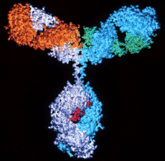
Safe for IBD patients to switch to biosimilar infliximab

Biosimilars/Research | Posted 24/02/2017

A UK study has shown that inflammatory bowel disease (IBD) patients can be safely switched from originator infliximab, Johnson & Johnson’s and Merck’s Remicade, to biosimilar infliximab using a managed-switching programme [1].